Cinder by Marissa Meyers
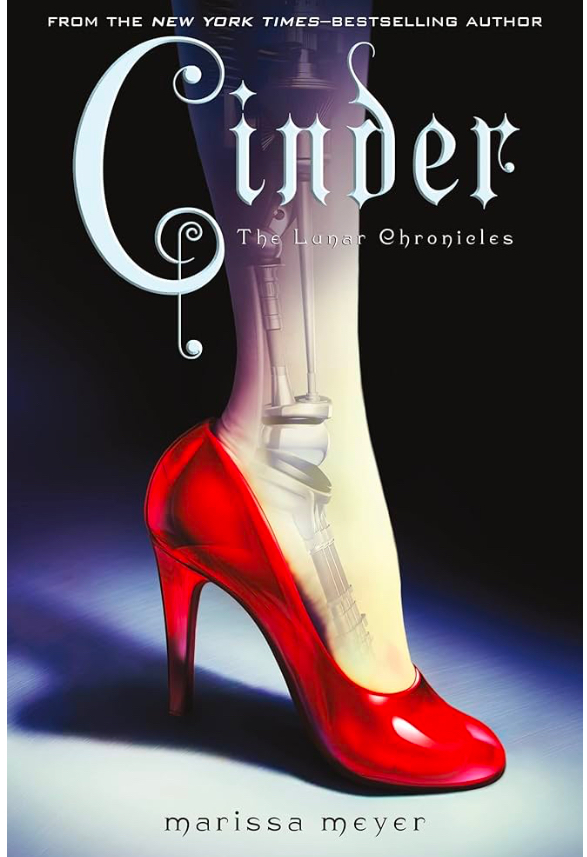 Cinder, the first book in the Lunar Chronicles series, is a sci-fi retelling of Cinderella. Set in a futuristic world where humans coexist with androids and a deadly plague threatens humanity, the story follows Linh Cinder, a 16-year-old gifted mechanic who is also a cyborg.
Cinder lives in New Beijing under the guardianship of her cruel stepmother, Adri, who blames her for their misfortunes. Her stepsisters, Peony and Pearl, have contrasting relationships with her—Peony is kind, while Pearl is more aligned with Adri’s disdain.
Cinder’s life changes when she meets Prince Kai, who asks her to repair his android, Nainsi. Unbeknownst to him, Cinder is hiding her cyborg identity, which is stigmatized in society. Meanwhile, a deadly plague called letumosis spreads, and Peony falls victim to it. Cinder is forcefully volunteered for medical experimentation, where she learns she’s immune to the disease. This immunity hints at a secret about her origins.
As Cinder uncovers truths about herself, she learns of the manipulative Queen Levana of Luna, a moon-based colony. Levana seeks to marry Prince Kai as part of a sinister plan to dominate Earth. Cinder must navigate her feelings for Kai, her self-identity, and the larger battle brewing between Earth and Luna.
The book ends on a cliffhanger, with Cinder escaping captivity and embracing her pivotal role in the rebellion against Queen Levana.
Review of Cinder
Marissa Meyer’s Cinder offers a compelling blend of fairy tale and science fiction. The novel shines in its world-building, creating a rich, futuristic setting where political intrigue, societal prejudice, and technological advancements collide.
Cinder herself is a strong, relatable protagonist. Her struggle with self-worth as a cyborg, juxtaposed with her innate bravery and determination, makes her a heroine worth rooting for. Prince Kai is more than a mere love interest, grappling with the weight of leadership and the threat of Queen Levana.
The pacing is brisk, balancing action, character development, and revelations seamlessly. Meyer’s ability to weave Cinderella motifs—like the ball and the lost “slipper” (a cyborg foot)—into a fresh, original narrative is commendable.
Some critiques include the predictability of certain plot twists and the fact that Cinder sets up more questions than it resolves, as it’s the first in a series. However, these aspects are forgivable given the scope of the larger story.
Overall, Cinder is a delightful read for fans of retellings, sci-fi, and strong heroines. It’s
Created with ChatGPT
Comments
Post a Comment